What We Learned From Tracking AI’s Search Recommendations
In the local business and search marketing industry, it is clear that AI has become and will absolutely be a major factor in 2027. As a result, we’ve spent a considerable amount of time optimizing for that shift.
AI Optimization Madness: Everyone Wants to Be First
AI Optimization – aka Answer Engine Optimization (AEO) and Generative Engine Optimization (GEO) – is all the rage these days. Businesses want to be the first to adapt and get ahead of the competition. The problem is that, in this industry, it brings out people who make empty promises to fulfill their desire to get ahead, when no one fully knows how to utilize it correctly yet.
The fact of the matter is (as of today, September 30, 2026):
- OpenAI (ChatGPT) and other AI Engines do not offer analytic reporting tools for businesses. Every 3rd party tool we’ve looked into is highly flawed and inconsistent.
- We have access to 100s of clients’ website data. Website visits and conversion data from AI Engines are an insignificant fraction.
- AI Engines are constantly updating and improving. What people thought worked yesterday doesn’t today, but may tomorrow. See the “Reddit Controversy“.
- Reliable website sources (Examples: Major News Publications, Review Sites (Yelp / Reddit), etc.) rely on website traffic to generate advertising revenue*. But if AI Engines are poaching their content, people no longer have to visit those other websites to find the answers they’re looking for. Fewer website visits mean less revenue and fewer jobs. So the question becomes: how much longer will these reliable sources let AI Engines use their content?
- If reliable sources are blocking AI Engines, what sources are they using for their local business recommendations? Are these sources we can trust?
*Note: Both Yelp and Reddit have licensing agreements with specified AI Engines. But apparently Reddit isn’t too happy about their deal. How long will these last and how fair are they?
Our Mission: Figuring out how AI Engines work for local business searches
There are lots of questions to be answered right now, but in order to offer a viable/valuable service to our clients, we needed to figure out how AI Engines work for local business search. Here at STLDM, we listen to the industry noise, take valid pieces of it, then develop our own internal optimization and reporting strategies.
Our first step in the process is to study search results over time and log the data. From there, we spot trends, execute via trial and error, and repeat.
How We Ran the Study
Over this past month, we used ChatGPT to conduct our research and tracked every local search result.
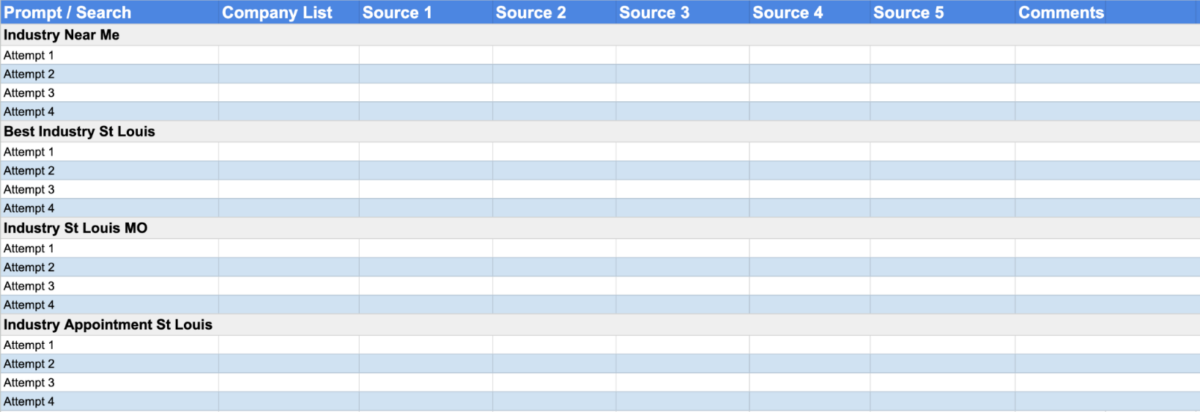
For each client’s industry, we selected 3-4 local search inquiries customers are most likely to use. Using an Incognito browser to minimize the influence of prior activity, we ran each query 4 times in a row.
For every search, we recorded:
- The businesses ChatGPT recommended
- The sources ChatGPT cited to support those recommendations
Here’s an example of our sheet’s layout:
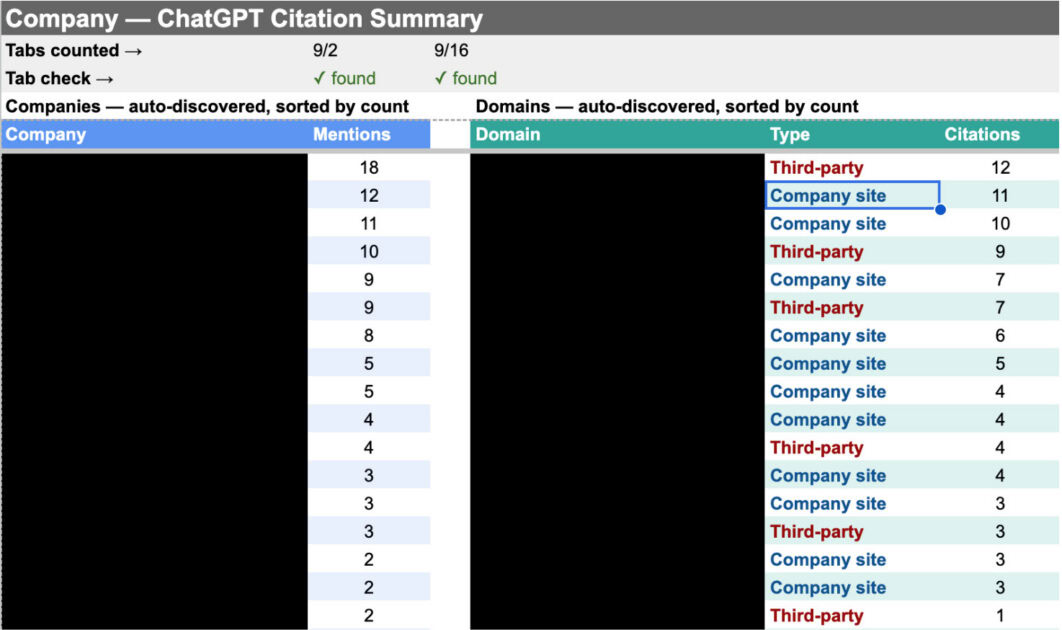
To summarize our data, we created a sheet that showed how often each company and domain appeared across all searches. We also classified each domain as either a third-party source or a company’s own website.
Summary Page:
Our Findings
Local Results Were Never Consistent
Even across 4 different attempts for the same local search keywords / phrases, AI rarely produced the same list of companies or citations. Companies that appeared in one attempt often disappeared in the next or shifted in rankings. This happens because AI models pull from different web sources each time, so there are no fixed positions like in traditional search.
Citations Used Are Weak
Many citations are unreliable third-party sources that can be easily manipulated. One of the top-cited sources within our search study for the moving industry was MoveBuddha.com. From what we can see, its rankings lack sufficient data to be trustworthy and may be open to manipulation in how it ranks companies. Many similar third-party websites exist across different industries, and if AI keeps relying on them, people will lose trust in the quality of its search results.
What We Believe Works for AI Exposure
Based on our research, these are the three consistent items we have seen from reliable industry professionals that potentially helped companies increase their local AI exposure:
Maximize Structured Data
Schema is hidden code on your website that tells search engines and AI bots exactly who you are without having to hash through all of the content on your website. The more schema info you have, the more easily they can read it. For years, we’ve implemented basic schema on all our sites as it is a basic SEO fundamental (name, address, phone number, etc.), but we are now expanding it to cover your services, service areas (if applicable), team members, industry/field specifics (ex: medical professional’s license credentials), and more. This gives AI a clearer, more reliable blueprint of your business and can list your information to potential customers more easily.
Audit Primary Platforms
AI models often cross-reference, so keeping your details identical across every platform is key. Whether it’s your Google Business Profile, Yelp, Facebook, or Instagram, consistent information will make it easier for AI to verify who you are and list you as an answer.
Prompt-Specific Reviews
Getting reviews for your business is always important, but it’s especially important to encourage customers to mention specific services, products, or staff names in their reviews. This helps AI extract these semantic phrases to match specific user prompts. For example, a review like “Lucy did a great job training our puppy!” helps your profile more than “great service!”
The full picture of how to optimize for AI is still unclear, but at St. Louis Digital Media, we are determined to keep running this research and test what works best for our clients! Schedule a free consultation today for any AI and SEO needs!