Everything To Know About ChatGPT’s Ads Manager (And Our Opinions On It)
ChatGPT has created an ads platform this year that any U.S. business can sign up for. At first glance, it seems like a program any business will want to jump on, since it lets them put their brand in front of anyone actively chatting with AI. As a reputable digital marketing agency, we test anything new before expanding it to our clients. So we ran some tests, and the results were interesting.
ChatGPT’s Ads Manager Timeline
Before we dive in, here is a timeline of how OpenAI has rolled out its Ads Manager.
- January 2026: OpenAI announces plans to bring ads to ChatGPT.
- February 2026: A labeled ad pilot goes live in the U.S. for Free and Go users. At this stage, access was limited to a small group of large advertisers working directly with OpenAI.
- March 2026: OpenAI begins testing an Ads Manager dashboard with a small group of partners.
- May 2026: A beta self-serve Ads Manager open to U.S. advertisers of all sizes, with no minimum spend and cost-per-click bidding added alongside cost-per-thousand impressions (CPM)
- Summer 2026: Expansion continues, including the UK in June and 31 European markets by the end of August, plus conversion tracking and attribution upgrades.
- September 2026: Bulk creation for product feed campaigns, a product review status feature, more flexible conversion reporting through the API, and an expansion into Southeast Asia and Taiwan.
What Does Ads Manager Do?
Ads Manager lets you create and manage campaigns and ad groups in one place. It allows you to set budgets and bids, target by location, and the reach of that targeting is growing with each update. For reporting, you can monitor basic conversion attributes like impressions, clicks, conversions, cost/conversion, etc. There is also API access for pulling data into your own dashboard.
OpenAI has a very specific format as well. Each ad includes:
- Brand Name
- Logo
- Headline
- A short product or service description
- A link to a landing page
- An image asset
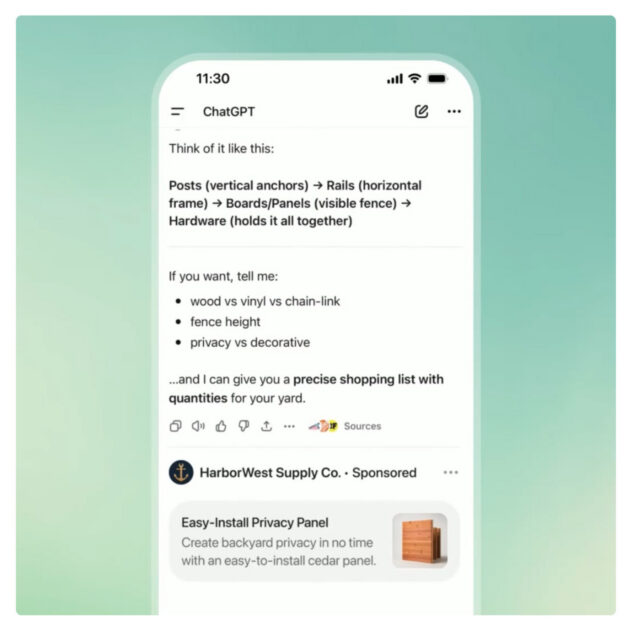
Ads appear as clearly labeled sponsored placements below ChatGPT’s answer, separate from the response itself. On October 5th, ChatGPT announced they are launching visual ads that appear alongside image generation results, which will start to appear later this month.
Who Actually Sees Your Ads
This is the first big limitation of ChatGPT Ads. Your ads are only shown to Free and Go-tier users. Higher-tier subscribers won’t see ads at all, which excludes some of the most engaged ChatGPT users. Ads also avoid sensitive topics such as politics and health.
What We Saw In Our Own Test
We wanted to see what kind of results this new platform produced ourselves, so we ran two web design campaigns through Ads Manager. One was set to maximize clicks, and the other was set to maximize conversions.
The Click Campaign
Over a reporting window of August 17th to September 14th, the campaign produced:
- Spend: $178
- Impressions: 6,917
- Clicks: 48
- Average CPC: $3.71
- CTR: ~ 0.69%
It took roughly 145 impressions to earn a single click, and each click cost about $4. The CTR was below 1%, similar to what other advertisers have publicly reported.
The Conversion Campaign
We expected the conversion-optimized campaign to matter most, but it never got off the ground. It earned no impressions and no clicks. With nothing delivered, we had nothing to measure and no way to tell whether the platform was actually doing its job.
What We Like
- The interface is intuitive. Setup feels familiar if you’ve used Google or Meta’s tools.
- API access is useful for visualization and custom reporting.
- The audience is high-intent. People are in the middle of solving a problem. Which is exactly when an ad can be most useful.
- It may bring in new customers. Criteo, an ad-tech partner, says more than 8% of the traffic comes from new customers rather than people who already know the brand.
What We Don’t Like
- It’s buggy. When something is newly launched, it’s bound to have some bugs, but we have found glitches across the interface. We’ve seen discrepancies when adding new users, using the dashboard, and viewing performance data, and some advertisers have even reported that rejected ads stay stuck even after resubmission.
- Traffic builds very slowly, and reach is limited.
- Relevance is inconsistent. Ads can’t adapt to what users are discussing, and many users have complained that ads interrupt conversations and feel unrelated to the problem they’re trying to solve.
- Reporting data is limited. For example, there is no place for us to view search terms to better target keywords.
More On Our Opinion
ChatGPT Ads Manager is moving fast. Almost every month, there has been a new update improving the platform, but right now it’s not the platform you have to jump on to get ahead.
For small and mid-sized businesses, the problem is the margin for error. Right now, based on our experience, it looks great for brand visibility but terrible for dependable conversions. A national brand can afford to spend on experiments, tolerate glitches, and wait for data. But smaller businesses may not be able to afford running experiments on a beta platform.
Who might still benefit?
- Businesses that need to hit their awareness goal, where impressions and new-customer reach matter more than actual conversions.
- Teams with a clearly capped experimental budget and the patience to track results over a longer window.
Here at St. Louis Digital Media, we’re going to continue to keep tabs on ChatGPT’s Ads Manager and other AI Marketing news so we can improve our services as things change. If you’re interested in learning more about how to optimize your business for AI and SEO, call us now for a free consultation!